Position as of October 2026. The rules for electricity sharing in the Czech Republic have changed several times since 2024; we verify the exact set-up for your building before filing a registration.
What electricity sharing in an apartment building means
Solar PV on the roof of an apartment building produces one stream of electricity, but there are twenty or seventy consumers in the building and each has their own meter. Sharing is the mechanism that allocates the generated electricity to individual flats without selling it to the grid and buying it back. The allocation is handled by the national Electricity Data Centre, which compares rooftop generation with consumption in the participating flats in fifteen-minute intervals.
The ratio used for the split is called the allocation key and the building sets it itself. It can be based on floor area, on the number of occupants, on each owner's contribution to the investment, or on anything else the owners' assembly agrees. In practice the allocation key is what holds up the decision longest, so it is worth having it ready before the investment is put to a vote.
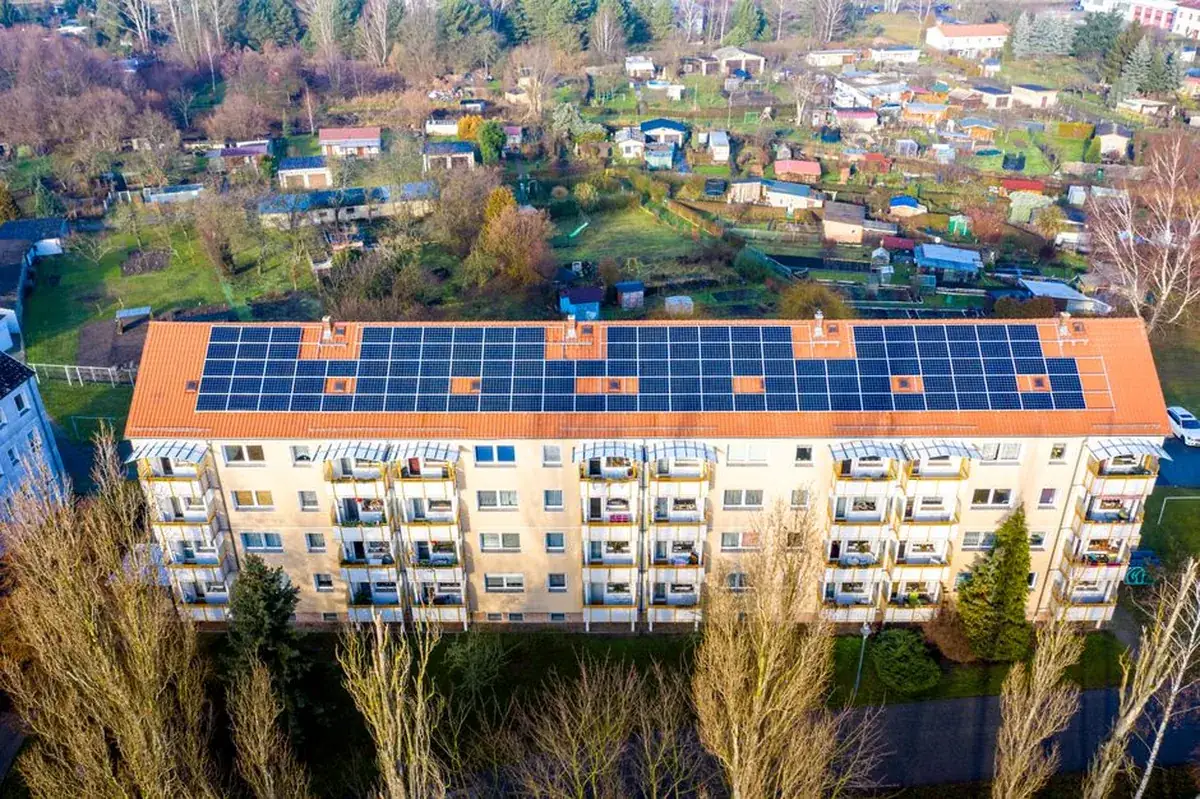
Two routes a building can take
| One connection point for the whole building | Sharing via the data centre | |
|---|---|---|
| How the distributor sees it | The whole building is a single connection point with one main meter; flats have sub-meters. | Each flat stays a separate connection point with its own contract. |
| Used inside the building | Typically 85 to 95 percent of generation. | Roughly 30 to 40 percent when allocated through the grid, considerably more when shared within the building. |
| Work on the wiring | Design work and rewiring, plus a change of tariff. | Minimal; the work is mostly administrative. |
| Choice of supplier | One supplier for the whole building. | Each flat keeps choosing its own supplier. |
| Watch out for | The annual standing charge for the building's main breaker, which has to be calculated before deciding. | A connection point can only be in one sharing group, so the two routes cannot be combined. |
The transitional regime and what changes in 2026
Sharing electricity inside an apartment building has been possible since the start of 2023, when the Czech Energy Regulatory Office allowed it by amending the market rules decree. Anyone sharing this way has to be registered with the Electricity Data Centre; by the end of April 2026 more than a thousand apartment buildings were.
Sharing still runs under a transitional regime. During 2026 the limits on member numbers and on the territorial scope of energy communities are being lifted and the data centre moves to full operation with extended functionality. Industry sources add that the simplified arrangement from the early years of sharing ends at the end of 2026 and that buildings using it must register with the data centre by then. We are verifying that date with the data centre directly and will confirm it before anything is filed.
Either way, registration needs a list of group members, an agreed allocation key and the connection point identifiers. Installing or replacing meters usually takes thirty to ninety days, so it cannot be left to the last minute.
What we do for an owners' association
- Consumption analysis: common areas, lift, lighting and pumps separately from the flats, so it is clear what is consumed regardless of any sharing agreement.
- Roof and load assessment, and a design for capacity and storage based on the real daily profile.
- Both routes costed for your specific building, including the effect on the standing charge.
- Material for the owners' assembly: allocation key options, draft resolution, costs and benefits per flat.
- Registration of the sharing group with the data centre and dealings with the distribution company.
- Installation, inspection, handover documentation and generation monitoring the building manager can see.
In apartment buildings the mistake is rarely technical, it is the order of steps. Settle the allocation key and the assembly's consent before anything is ordered. Technology can be adjusted later; an agreement between seventy owners cannot.